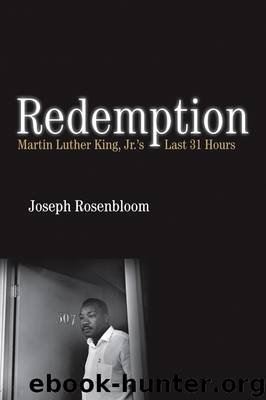
Redemption by Joseph Rosenbloom
Author:Joseph Rosenbloom [Rosenbloom, Joseph]
Language: eng
Format: epub
ISBN: 9780807083406
Publisher: Beacon Press
Published: 2018-02-16T05:00:00+00:00
Chapter 14
Summoning Dr. King
And so I call upon labor as the historic ally of the underprivileged and oppressed to join with us in this present struggle to redeem the soul of America.
—MLK, speaking to the Illinois State AFL-CIO, Springfield, Illinois, October 7, 1965
WHILE JAMES EARL RAY was holed up in the New Rebel Motel and a thunderstorm was raging outside, hundreds of strikers and their supporters were filtering into Mason Temple to hear King speak. They clustered in the front section, shedding their rain-spattered jackets as they took their seats. Looming above them was a raised platform from which King would speak. All eyes were turned expectantly toward the front. King was not yet there.
Almost lost in the overwhelmingly African American crowd was a sprinkling of white faces. Mike Cody, the young white lawyer assisting Lucius Burch to fight the federal injunction against King, was in the central, main-floor section near the podium. That section of the auditorium was packed with people. Cody would remember the air feeling stuffy, a sense magnified by the fury of the storm outside, its thunder and lightning stifling the crowd’s murmuring to speakers’ remarks from the podium.1
On this Wednesday night, though, the crowd filled at most half the seats in the vastness of Mason Temple. Estimates of the turnout would range from two thousand to four thousand.2 In its edition the following morning the Commercial Appeal would term the audience “disappointingly small.”
The sparse turnout was a setback for the garbage workers, who had little reason to believe that their strike would end with a favorable outcome anytime soon. If they were losing heart, they were not without hope. They had faith that the man they knew reverently as Dr. King might somehow shift the momentum of the strike to save the day. (The honorific recognized the doctorate in systematic theology King earned at Boston University in 1955.)
Union leader Joe Warren would say: “We ain’t never had a man, black or white [who was the equal of Dr. King].”3 Taylor Rogers, another garbage worker in the crowd, would remember waiting eagerly to hear King speak again. Rogers had thrilled to King’s speech on March 18. “It had ignited a much needed spark,” he would later recall.4
The March 18 speech had boosted the strikers’ spirits at a critical moment. Some workers who were initially on strike but who had returned to their jobs were so stirred by King’s words that they had rejoined the strikers’ ranks. Now Rogers was expecting another speech packed with power and emotion. He was praying that King’s return to Memphis marked a turning point that would lead to victory for the strikers.
As the rally was getting under way, the storm bearing down on Memphis was lashing King’s motel room with torrents of rain. He could hear the roar of thunder and see fearsome lightning strikes through the motel window. Worse, the scream of sirens continued to warn of tornadoes (which would strike nearby areas in Arkansas and West Tennessee, destroying houses and leaving two people dead and many injured).
Download
This site does not store any files on its server. We only index and link to content provided by other sites. Please contact the content providers to delete copyright contents if any and email us, we'll remove relevant links or contents immediately.
Fanny Burney by Claire Harman(26616)
Empire of the Sikhs by Patwant Singh(23095)
Out of India by Michael Foss(16866)
Leonardo da Vinci by Walter Isaacson(13352)
Small Great Things by Jodi Picoult(7171)
The Six Wives Of Henry VIII (WOMEN IN HISTORY) by Fraser Antonia(5526)
The Wind in My Hair by Masih Alinejad(5110)
A Higher Loyalty: Truth, Lies, and Leadership by James Comey(4975)
The Crown by Robert Lacey(4827)
The Lonely City by Olivia Laing(4811)
Millionaire: The Philanderer, Gambler, and Duelist Who Invented Modern Finance by Janet Gleeson(4493)
The Iron Duke by The Iron Duke(4373)
Papillon (English) by Henri Charrière(4283)
Sticky Fingers by Joe Hagan(4213)
Joan of Arc by Mary Gordon(4125)
Alive: The Story of the Andes Survivors by Piers Paul Read(4042)
Stalin by Stephen Kotkin(3977)
Aleister Crowley: The Biography by Tobias Churton(3651)
Ants Among Elephants by Sujatha Gidla(3476)
